
Waxhaw City Directory Collections
There is no verified standalone printed run for Waxhaw. The strongest historical substitute is a set of Monroe and Union County volumes that can include rural and street material relevant to Waxhaw. Treat each volume as a dated snapshot, not a complete roll of town residents. The local collection, the digitized record, and the page itself all matter because coverage can change from one issue to the next.
| Collections | Years | Where Held | Access |
|---|---|---|---|
| Monroe City Directory | 1922-1923 | DigitalNC and UNC North Carolina Collection | Online catalog and viewer |
| Miller’s Monroe | 1942-1943 | DigitalNC; local call C971.90 M75m1 | Online record and local-history use |
| Miller’s Monroe | 1951-1952 and 1955-1956 | DigitalNC | Online digitized volumes |
| Miller’s Monroe criss-cross material | 1958-1959 | DigitalNC | Online viewer or PDF, key required |
| Miller’s Monroe | 1962-1963 | DigitalNC | Online digitized volume |
The gaps are real. A missing name can mean that a volume omitted the rural area, used a different spelling, or did not list that household. Begin online, then use the Dickerson Genealogy & Local History Room for print, electronic, and staff-supported research. The room also connects directory work to newspapers, Sanborn maps, photographs, obituaries, and library databases.
DigitalNC Waxhaw Directory Years
DigitalNC’s 1958-1959 Miller’s Monroe record is the verified source for the later criss-cross material, including the Waxhaw Road street reference. Open the record or its viewer rather than relying on search snippets. That preserves the directory year, the page, and any key that explains symbols or abbreviations.
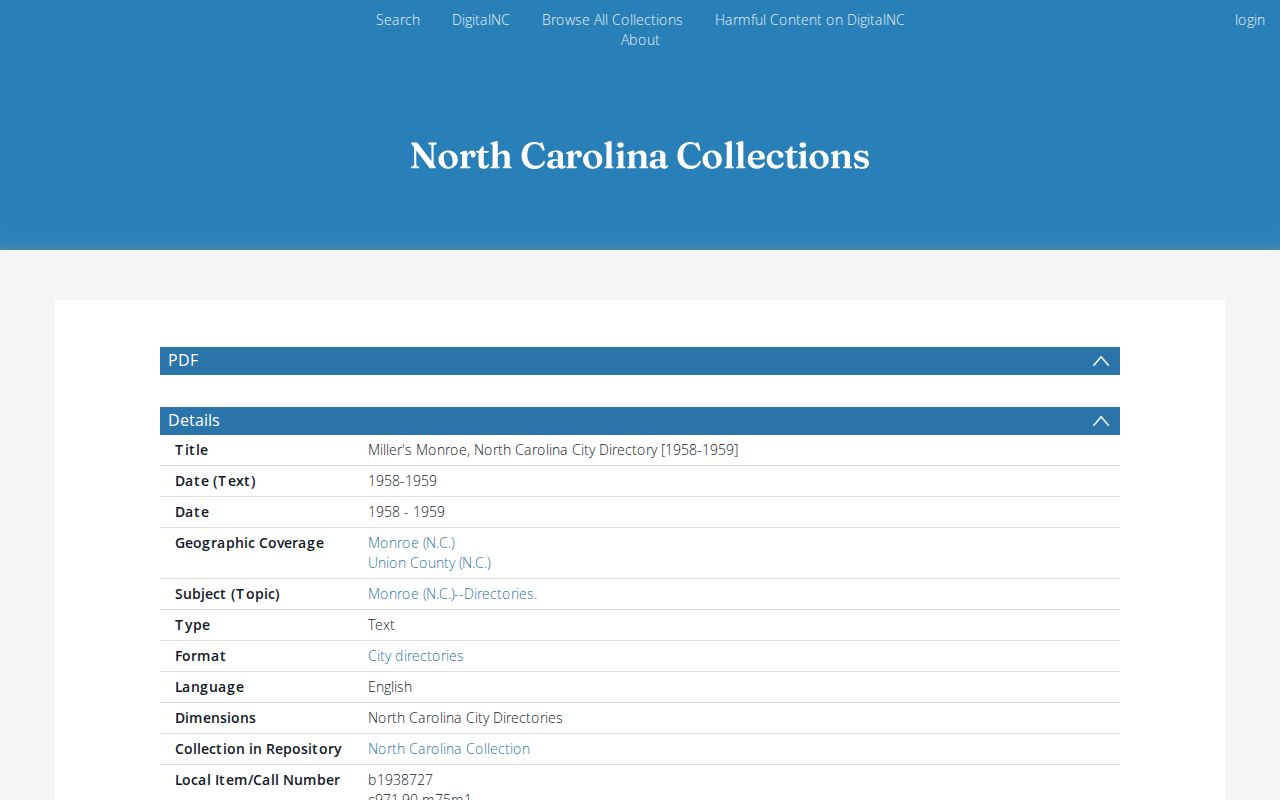
The displayed record shows why a street listing is not a simple current-address result. Its value is the original arrangement of the names and addresses on that dated page.
DigitalNC’s 1942-1943 Miller’s Monroe record provides an earlier comparison point. Search the person and street both ways, then save the catalog link with the exact page or PDF location used for the conclusion.
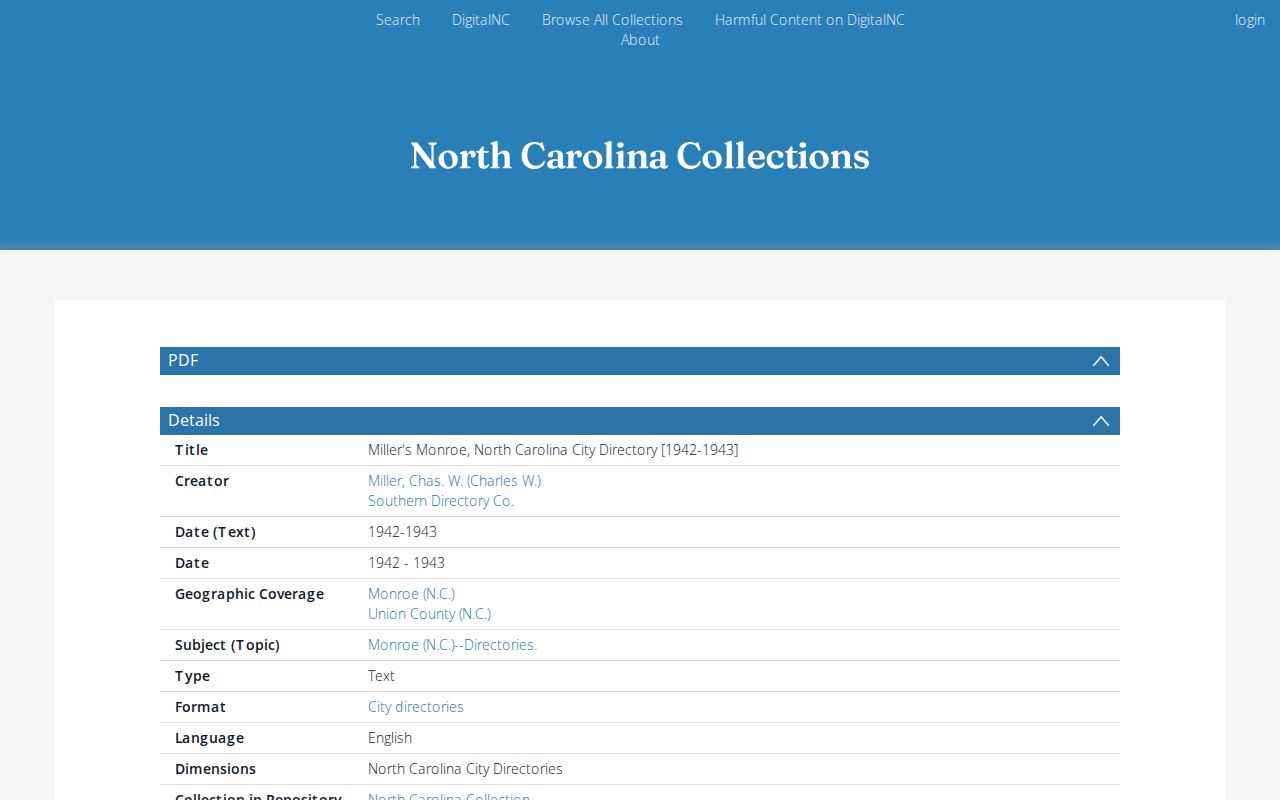
Comparing the earlier volume with a later issue can show a change in listing style, but it cannot establish that two same-name entries are the same individual without supporting evidence.
Note: DigitalNC holds the verified runs, while page-by-page coverage decides whether a Waxhaw-area household actually appears in a given issue.
Reading a Waxhaw City Directory Entry
A directory entry should be copied as printed before it is interpreted. The 1922-1923 volume includes a pattern such as a person’s name, a spouse in parentheses, an employer or occupation, and a home notation. Later street material may add a house number, honorific, cross-reference symbol, or parenthetical code. Separate a person entry from a business or government listing before using it as household evidence.
| Printed name | Use the spelling, initials, and honorific exactly as shown. |
|---|---|
| Household notation | A spouse may appear in parentheses, but verify the relationship elsewhere. |
| Work line | Occupation or employer identifies the entry’s historical context, not a present address. |
| Street line | Record the house number, street form, rural label, and page. |
| Code or symbol | Copy it with the volume’s key; do not guess what @ or a parenthetical number means. |
- Criss-cross directory
- A section arranged by street and house number, useful for locating a printed occupant entry at a known historical address.
- Householder index
- An alphabetical aid that points to the listed household or entry; it does not by itself prove ownership or family ties.
- Abbreviation key
- The directory’s own legend for symbols and shortened words. Capture that page before interpreting any marked entry.
Waxhaw Directory Keys Need Context
The 1958-1959 street material labels Waxhaw Road as a continuation of W Franklin beyond the city limit. That is a useful historical road clue, not proof of the current municipal line. Waxhaw’s postal and town boundaries have changed in meaning over time, so a modern map should not be projected backward onto a printed street page.
The same caution applies to directory codes and OCR. Historical pages can contain @ marks, parenthetical numbers, honorifics, and occupation abbreviations, while OCR can miss initials, punctuation, or columns. Pair the exact text with the key, the page image, and the directory year. A code cannot safely be converted into an ownership or relationship claim unless the volume itself defines it.
Waxhaw City Directory Room Access
The Union County Library genealogy and local-history service is the practical access point for collections that are not solved by an online keyword search. The Dickerson Room offers print and electronic sources, original manuscripts, library-premises Ancestry access, HeritageQuest through NC LIVE for eligible cardholders, Sanborn maps, newspapers, photographs, and obituary help.
Dickerson Room obituary assistance is available at 704-283-8184 ext. 5236 and ucpl.genealogy@unioncountync.gov. Listed hours are Monday through Wednesday 9-5, Thursday 9-7, Saturday by appointment, and Sunday closed. The Main Library is at 316 E Windsor Street in Monroe; Southwest Regional Library at 1720 Cuthbertson Road in Waxhaw provides a local branch route. Call or email before a special visit, especially for Saturday work.
Library sources can be reached online, in person, by phone, or by email. For a defined historical item outside the library’s holdings, use the State Archives copy-request route with the record series, county, date range, and known page or book reference.
DigitalNC, NC Digital Collections, library databases, newspapers, and Sanborn material are the online layer. If that layer does not identify the page, shift to an in-person Dickerson Room, Southwest Regional, Museum, or Archives visit, then use phone, email, or a narrow written request for a specific item. This sequence avoids asking a custodian to create a history that no existing record contains.
Waxhaw City Directory Archive Routes
The Museum of the Waxhaws local-history collection adds the town’s charter, settlement, road, and surname context to a directory lead. It is a historical institution, not a modern people list. The museum is at 8215 Waxhaw Highway and lists 704-843-1832, so a visitor can ask what collection material or local context is available before traveling.
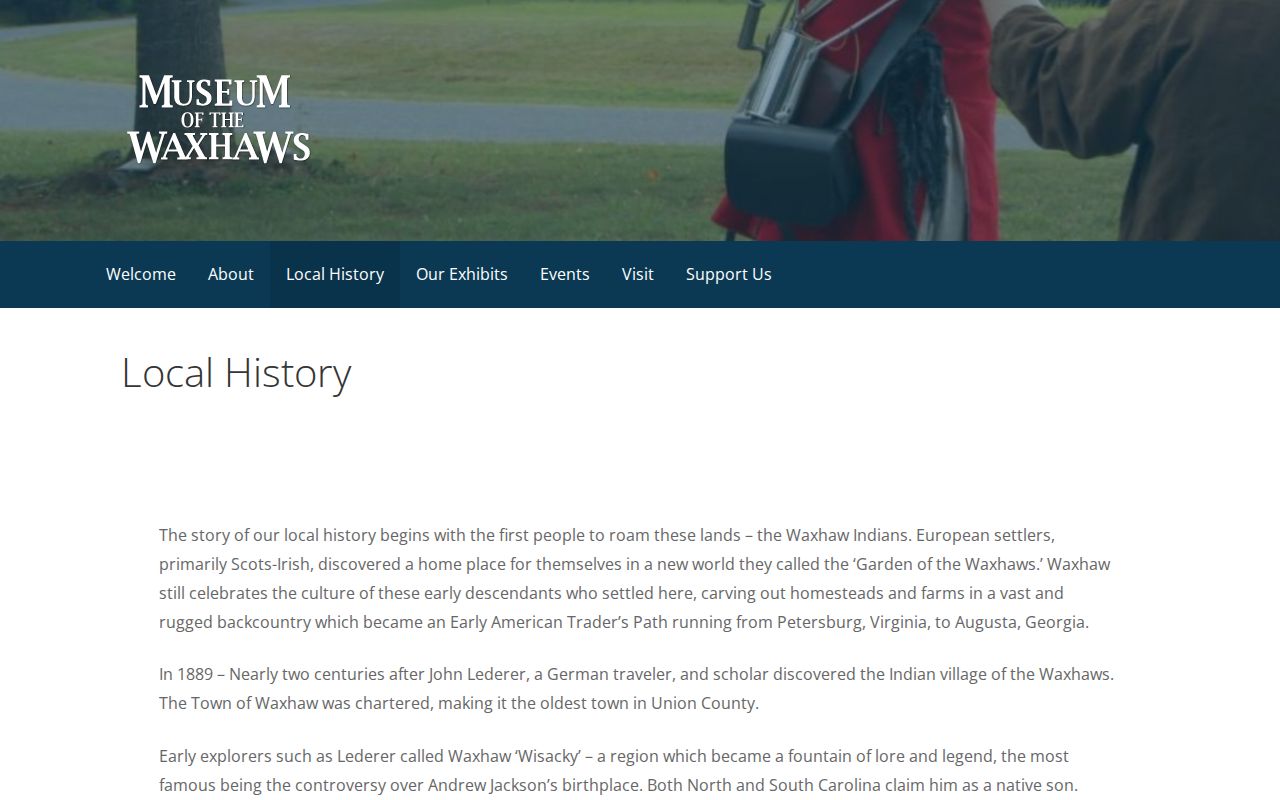
The museum source helps place an entry in Waxhaw history, while the directory page and a named county or state record remain the evidence for a particular historical claim.
The North Carolina State Archives county-record guide adds Union County land, court, estate, marriage, tax, will, and election series. Its Union County Miscellaneous Records collection covers 1844-1967. The Archives accepts targeted online or mail copy requests for records such as deeds, court minutes, maps, wills, and WPA cemetery surveys; in-state research has no upfront search fee, while copy charges and out-of-state terms apply.
Waxhaw City Directories and Union County
Waxhaw was chartered in 1889, while Union County dates to 1842. Older county material can therefore predate a municipal Waxhaw label. The digitized books are Monroe and Union County directories rather than a continuous town series, and their rural or street sections must be checked for the period in question.
A “Waxhaw” mailing label also does not prove that a location falls inside current town limits. For an address question, compare the historical page with the appropriate dated record and, where needed, current town mapping or county GIS. For present-day address-keyed work, use the Waxhaw streets resource rather than treating a historical entry as a current address result or town-status finding.
Note: A directory establishes what was printed for that edition, not a continuous residence history or a present municipal classification.
Waxhaw City Directory Timeline
These verified dates set useful bookends for a directory search. They also explain why one source cannot fill every year between an old street reference and a modern record.
- 1922-1923: Commercial Service Co. published the verified Monroe City Directory volume.
- 1942-1943: Southern Directory Co. issued a Miller’s Monroe comparison volume.
- 1951-1952 and 1955-1956: Digitized Miller’s Monroe volumes offer later household and street checks.
- 1958-1959: The verified volume includes criss-cross or street-listing material.
- 1962-1963: The later DigitalNC volume provides another comparison point for continuity or change.
Between printed years, use census material available through library resources, newspapers, obituaries, deeds, and archives records. Each source answers a different dated question.
Trace Waxhaw City Directory Households
Start with the earliest verified appearance of a name or address, then build a dated trail. Preserve the directory year, page or PDF location, exact printed name, household notation, work line, street line, code, and a short match-confidence note. That method makes a later correction possible when a spelling, symbol, or street name is read differently.
- Find the first likely entry and capture the original image or PDF page.
- Follow the name through each available directory year, recording moves and spelling changes.
- Check the criss-cross section when available to see the printed street order and adjacent entries.
- Pair each directory period with the relevant census, newspaper, obituary, deed, or archive record.
- Mark the result confirmed, probable, possible, or not a match according to the supporting evidence.
A disappearance may reflect a move, death, changed listing practice, rural coverage gap, or simple omission. Do not choose among those explanations without a dated source. Modern verification can follow through the Waxhaw resident lookup routes when the research question moves from history to a current official record.
Waxhaw Directory Formats Compared
A 1922-1923 Monroe and Union volume and a 1958-1959 criss-cross volume arrange evidence differently. The earlier book can supply household and work notation, while the later street-oriented material is useful when the historical address is known. Neither format replaces the other.
| Directory form | Best question | Critical check |
|---|---|---|
| Alphabetical household entry | How was this person or household printed? | Spelling, spouse notation, and year |
| Criss-cross street section | What was printed at this historical street position? | Street key and house number |
| Library or archive companion source | Can the lead be dated or supported? | Custodian, original image, and record purpose |
Note: Directory comparisons are strongest when both source pages are retained with their date, publisher, and any explanatory key.