
Waxhaw Previous Residents by Era
One address can produce several trails. Deeds document recorded transfers, tax listings tie a parcel to a dated owner field, and historical directories may supply a household lead. The online coverage does not form one continuous list of past residents. In particular, the Union Register of Deeds places deeds online from 1973, while its maps extend to 1842. Earlier evidence often belongs in library, archive, or in-person research rather than a web search.
| Source | Years it covers | Where held | What it shows |
|---|---|---|---|
| Union deed index | 1973 onward online; maps from 1842 | Union Register of Deeds and deed imaging | Recorded parties, book, page, instrument, and deed image path |
| Tax real-estate listing | Permanent listing from January 1, 1987 | Union Tax Administration | Parcel, physical address, owner field, assessment and sales details when populated |
| Monroe and Union directories | Verified volumes: 1922–23, 1942–43, 1951–52, 1955–56, 1958–59, 1962–63 | DigitalNC and Union County Library | Printed names, household notation, street or rural listings, and directory codes |
| Union County Miscellaneous Records | 1844–1967 | North Carolina State Archives | A date-bounded historical county source across several record categories |
For a recent transfer, start with the parcel card and deed index. For a mid-century address, use a verified directory volume and retain its page image. For an earlier question, the State Archives county guide and a targeted records request are more realistic than expecting an online name search. Each source should be cited as a dated time slice.
Waxhaw Past Residents Start With PID
Begin a past-resident trail with the current physical address in Union Real Property Search. The public card can display a parcel ID, owner, legal description, market and assessed values, sales history, and permit details when populated. Record the PID before opening a deed index. The PID turns a familiar street address into the parcel reference that can be checked against the legal description, map, and sale record.
UC Atlas is the next comparison point. Its parcel, address-point, imagery, ZIP, polling, zoning, and FEMA layers help distinguish a physical address from its mailing and jurisdiction labels. A county GIS result is not a legal boundary or survey. Use the recorded deed or plat for that purpose, and retain the portal timestamp because parcel and address-point data have different update cycles.
The official property search begins with Parcel, Address, and Owner choices.
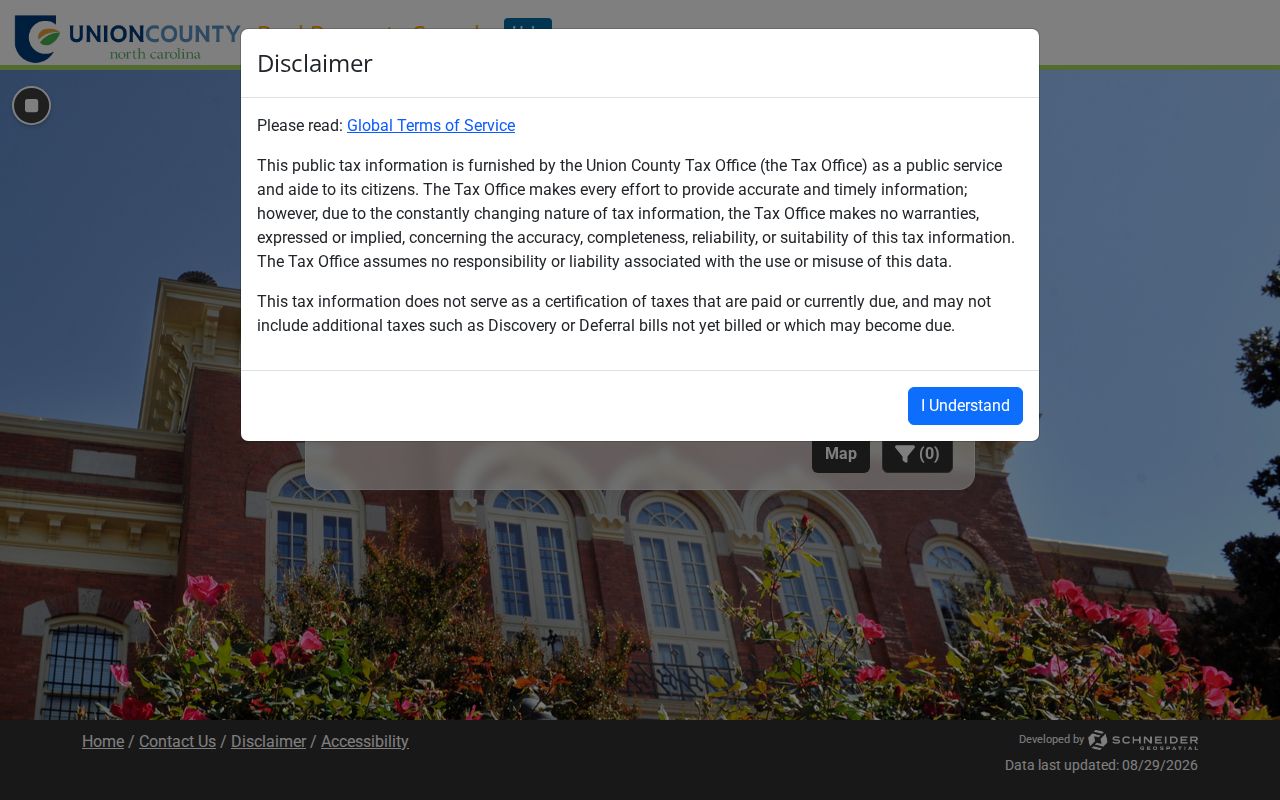
That address-first step supplies the legal name needed by the name-based deed index. Save the PID and the displayed data date before comparing later source images.
Trace Waxhaw Previous Residents Through Deeds
The deed chain traces recorded interests, not every person who occupied an address. Start from the property-card owner and sales history, then move from the current grantee’s acquisition backward through the preceding grantor. Confirm the parcel’s legal description at each turn. A street number can change or be missing in older material, while a legal description, lot reference, book and page can carry the connection across a name change or road-label change.
- Save the current PID, owner field, physical address, legal description, and the card’s data date.
- Use the owner or sale-history names in the Union deed imaging index, then record the book, page, instrument, grantor, grantee, and recording date.
- Read the instrument image and compare its legal description with the parcel card. Do not rely on the name alone.
- Search the seller as a grantee to locate the earlier acquisition, then repeat the comparison backward.
- When the needed instrument falls before the online deed coverage, ask the Register of Deeds or the State Archives for the relevant book, page, map, or historical series.
- Grantor
- The party conveying a recorded property interest in an instrument.
- Grantee
- The party receiving that recorded interest.
- Chain of title
- A sequence of recorded transfers connected by the legal description and instrument references.
- Legal description
- The deed’s land description, which can remain useful when a street address changes.
The Union deed imaging route shows the book-and-page approach used for an instrument image.
Preserve the recorded reference and image date with each link in the chain. The image should be read with the legal description and party roles, not as a name-only result.
Waxhaw Address History Before 1973
Online access has a real edge. Union ROD describes deeds online from 1973 and maps from 1842. Tax Administration’s permanent real-estate listing begins January 1, 1987. These dates identify what each system can support; they do not mean that a property began then. For earlier instruments or a missing deed image, contact the Register of Deeds rather than guessing from a modern parcel card.
Union ROD is at 500 North Main Street, Suite 239, Monroe, NC 28112, with mail at PO Box 248, Monroe NC 28111, phone 704-283-3843, and recording hours Monday through Friday, 8 a.m. to 5 p.m. The office records deeds, plats, powers of attorney, miscellaneous real estate, and related series. County-recorded covenants or CCRs may require a second-floor office search. Liens and judgments belong with the Clerk of Superior Court, not the online deed site.
For county records held elsewhere, make a narrow Chapter 132 request to the custodian. State the record series, date range, person or parcel reference, desired electronic format, and a fee estimate before extensive processing. The law permits inspection and copies but does not require an agency to create a record that does not exist.
Waxhaw Previous Residents in Directories
Recorded owners are only one part of an address story. The verified digitized substitute for a standalone Waxhaw printed directory is the Monroe and Union County set. DigitalNC provides volumes for 1922–23, 1942–43, 1951–52, 1955–56, 1958–59, and 1962–63. Coverage and rural-section inclusion must be checked page by page. A printed entry may include a person’s name, spouse notation, street, home or business notation, and abbreviations that need the directory key.
The 1958–59 Miller’s Monroe volume includes Waxhaw Road criss-cross material. It can show a street heading, house number, name, honorific or abbreviation, cross-reference symbol, and parenthetical page or number code. Use it as a dated household lead. Do not turn a symbol into proof of ownership or relationship, and do not treat an old entry as a current address claim.
Open the official 1958–59 Miller’s Monroe directory record before interpreting a street page.
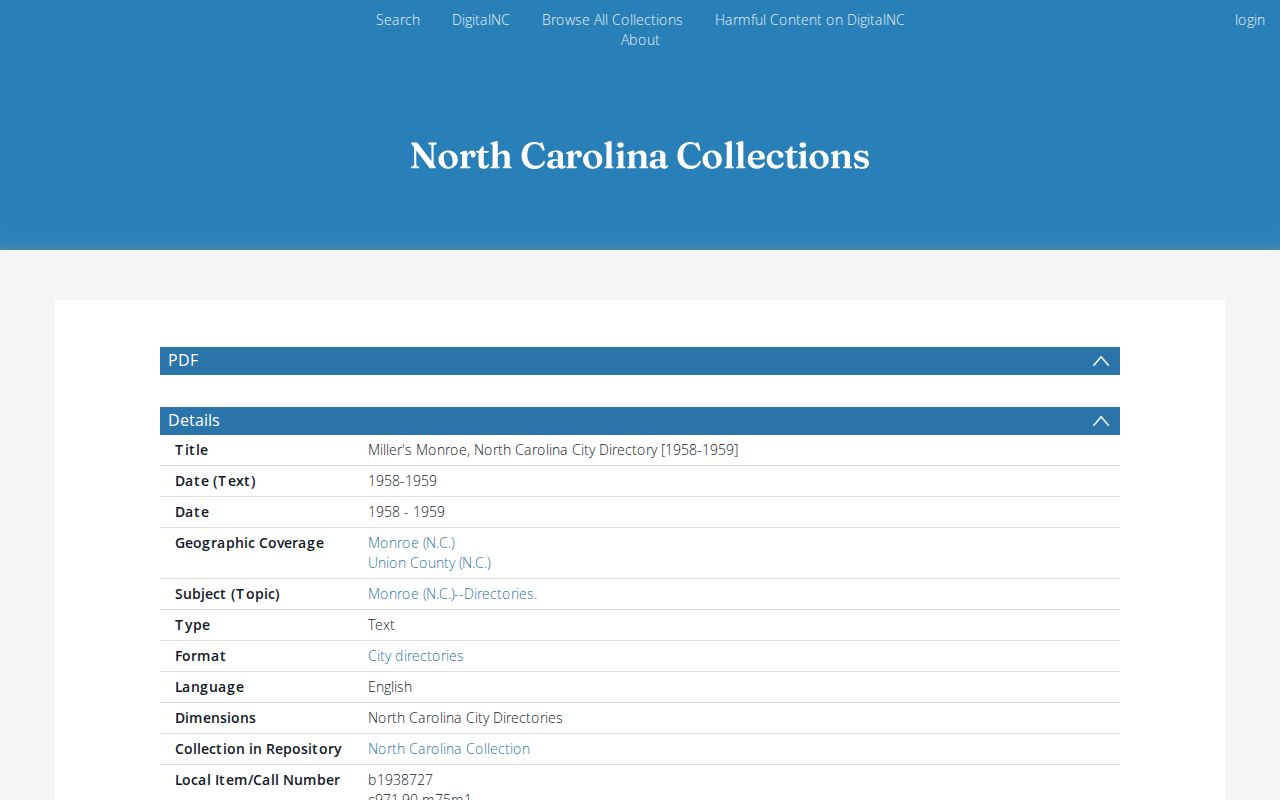
The source viewer and its key are part of the evidence, not an optional extra. Record the directory year, printed line, code, and page when comparing it with a parcel or deed record.
The collection itself is discussed in greater depth in the Waxhaw city directory collections, where each verified volume is tied to its DigitalNC record.
Pair Waxhaw Past Residents With Census
Use a directory entry to construct a careful household question, then check the corresponding census and local-history sources through the library. Union County Library genealogy resources include Ancestry on library premises, HeritageQuest through NC LIVE with a valid library card, census material, newspapers, Sanborn maps, photographs, and obituary help. HeritageQuest at home includes census and city directories, subject to its library-card access conditions.
- Capture the directory year, printed name, address or street heading, spouse or household notation, code, and source page.
- Use the closest available census period through the library resource, keeping the census citation separate from the directory citation.
- Compare only concrete details such as the printed address, known family notation, date, and place. Mark a match as possible until multiple sources support it.
- Use newspapers, obituaries, Sanborn maps, or a deed image to test a date or address connection, then save the original page or image.
For research help, the Dickerson Genealogy & Local History Room lists 704-283-8184 ext. 5236 and ucpl.genealogy@unioncountync.gov. Its listed hours are Monday through Wednesday 9–5, Thursday 9–7, Saturday by appointment, and Sunday closed. Southwest Regional Library is listed in Waxhaw, while the Dickerson Room is at the Main Library in Monroe.
Waxhaw Past Residents and Road Names
The 1958–59 criss-cross material’s description of Waxhaw Road as a continuation of W Franklin beyond the city limit is a useful comparison clue. It should not be read as a present municipal boundary. Waxhaw’s municipal context has changed over time, and its 1889 charter postdates Union County’s 1842 formation. Earlier county records may not use a modern Waxhaw label at all.
That makes historical road research a three-date exercise: preserve the USPS delivery result date, the parcel or map data timestamp, and the record date from the deed, permit, or directory. A road label can be current in one system and historical in another. The official key and source image protect against overreading an abbreviated line or a @ code.
Note: A historic street label is a search lead, not proof that today’s municipal boundary or street-number pattern applied at the earlier date.
Waxhaw Historic Address Archives
When a deed chain reaches beyond the online index or the directory shelf ends, use the North Carolina State Archives county-records guide. Its Union County Miscellaneous Records collection covers 1844–1967, and the county guide also points to land, courts, estates, marriage and vital records, taxes, wills, elections, original records, and microfilm. Those series have different search paths, so name the specific record category rather than asking for a general past-resident file.
The State Archives copy form accepts targeted requests for deeds by book and page, WPA cemetery surveys, land grants, court minutes, estates, wills, marriage or divorce records, maps, military or pension files, and other series. In-state search has no upfront search fee; copies cost $2 up to 20 pages and $0.10 per page after that, with four color scans. Out-of-state requests require $20 upfront with the same copy limits.
The North Carolina State Archives county-records guide identifies the wider historical route.
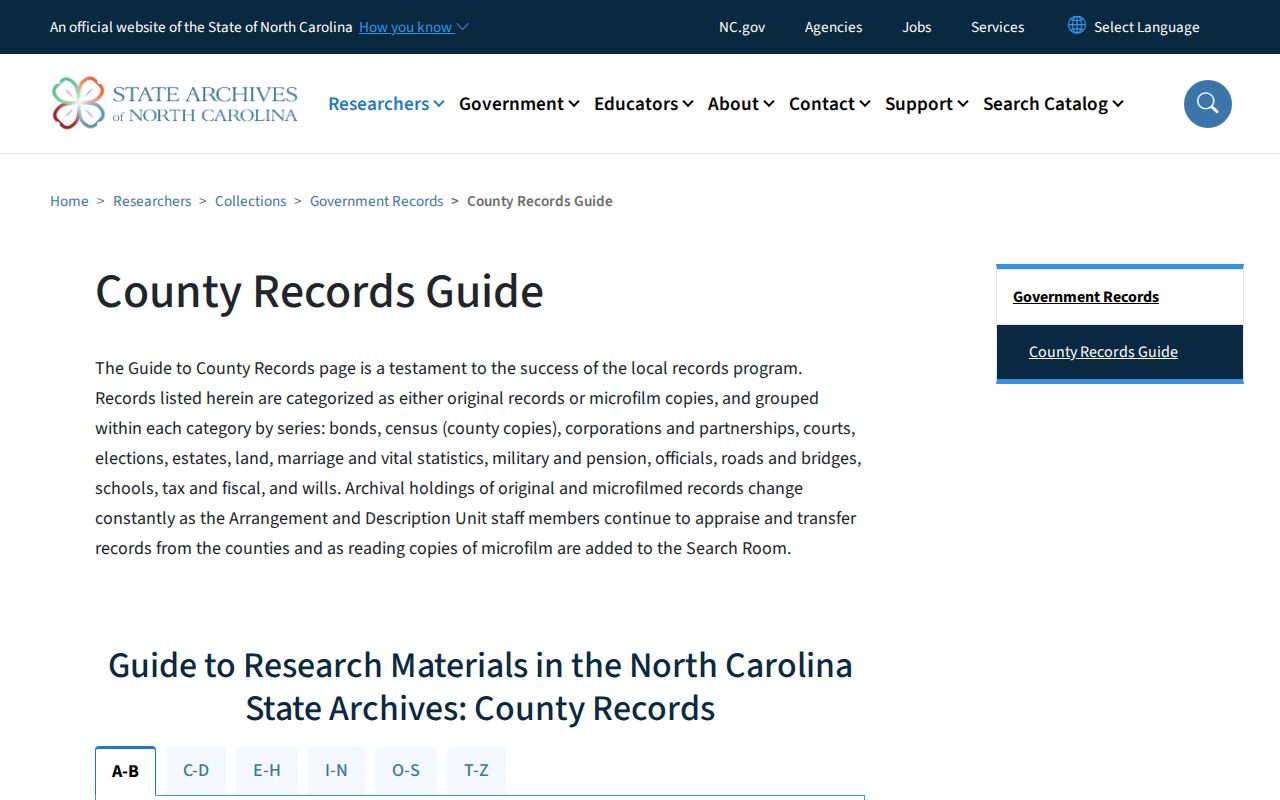
A targeted series and date range give the archives a usable request, especially when the address itself is absent from an early index. The response can identify where an earlier book or microfilm path should continue.
Limits on Waxhaw Previous Residents
Past residents, owners, and address users are not interchangeable labels. A deed records a transaction. A tax card reports property fields. A directory preserves a printed entry from its year. An obituary can be a lead to another record. Public sources may omit protected addresses and sensitive fields, while an apparent name match can belong to a different person. Do not merge entries without the parcel, date, source image, and other supporting facts.
Use online portals first when they fit the record, then the ROD, Assessor, GIS, town or county counter, phone, email, mail, or public-record request. The library and Museum of the Waxhaws can supply local-history context. The State Archives can reach older county series. The official access route is the right fallback when a public web index has no result.
Lawful use. Address history is appropriate for family history, estate questions, preservation research, and careful personal curiosity. Do not use old records to expose a protected location, stalk, harass, threaten, or impersonate anyone.